Sunday, May 17, 2015

Sponge Cities

Sponge City, 12 in  x 18 in, watercolor and paper collage

I have not  posted for 6 months.  Mother nature hasn't been kind to us. In Oklahoma, we survived drought, earthquakes, tornadoes, and floods. I used to get tickets from the city for wild flowers growing too tall, lawn exceeding 18 inches, and now, the tie changes.  I was so happy to know in L.A. people quit washing car and proudly display their dirty cars to conserve water. My pretty un-unified lawn and overgrown shrubs and trees are my way to let it be.

However," let it be" for water conservation is , in fact,  not a good idea. Water, come to us, please.

We all know the Inca, just like the Romans were great masters of water systems.  Thanks to the combination of agricultural terraces and efficient waterways, the Incas had managed to bring fresh drinking water from mountain streams to provide water during drought times for centuries. I remember when I lived with my grandma in the country side, she would hand me a soap to wash myself with when it rained to save water. Lately, I notice the city of Chicago has to dig a humongous tunnel to lead runoff water to a huge pond.

This brings up the possibility of building a sponge city ( not the tourist attractions or where to dine) to collect water. This is the least we can design in the shadow of Roman and Inca's ingenuous adaptation of aqueducts.

Links:

Building Sponge City

Sunday, February 22, 2015

A Last Look

by W.S. Merwin
Even the words are going somewhere urban
where they hope to find friends
waiting for them
some of the friends will think of trees as pleasant in a minor
     way
much alike after all
to us
some of the friends will never be aware of a single tree
they will live in a world without a leaf
where the rain is misfortune


                                                                               ***


So bright
Like jewels
Glistening
What I cannot capture
I took it out
Sorry, emerald green

- yiren


Friday, September 19, 2014

China's Great Green Wall


In a Geico commercial, the Mongol army stopped at the Great Wall and asked "What should we do?” We know from history that the Mongol armies marching through the gate eventually overturned the Song Dynasty. Nowadays, Chinese, themselves, ask the same question "what should we do?” This time, the relentless foe to the capital city is a sandstorm blowing from the northern desert. In the north-west, north and north-east of China, starting in 1978, row of trees designed to protect Beijing from sandstorms with a goal to last for 73 years, cover an area of 4.069 million square kilometers (42.4% of China’s total territory) to surpass Roosevelt’s Great Plains Shelterbelt and Stalin’s Great Plan for the Transformation of Nature. The ambitious “Three North Shelterbelt Project" is by far the world's largest tree-plant project. This was to be China’s “Green Great Wall”.

I knew neither the scale of the desertification in China nor the huge number of people in Inner Mongolia who have been move off land. A big portion of the trees that were planted are withering. Many have died of age as those grown from cuttings have a shorter lifespan. Afforestation in China is a serious business. It is not just planting trees but a monumental effort to restore the productivity of the soil.  Furthermore, it seems the idea that wealthy industrialized countries invest money to adopt tropical forests and pay indigenous people to be rainforest police in order to protect trees is a win win situation. 


***
In early September, famed primatologist and conservationist Jane Goodall visited Tulsa and opened her talk to students of a private school, one of the member sites of her Roots &Shoots program. Before leaving Tulsa, Dr. Goodall helped to plant a tree which she affectionately named “Treebeard” on the West side of the River (in the Arboretum off 21st Street).

https://www.upwithtrees.org/files/2814/1082/0020/Dr._Goodall_small.jpg


Monday, April 14, 2014

The Bloody Tomatoes


The remote Xinjiang Uygur autonomous region is not only a steady oil, coal and gas provider, powering China's economic development, it also gives the nation's people, and even people around the world, good things to eat. There are juicy, sweet Turpan grapes and Hami melons, yet Xinjiang is most famed for its ripe, red tomatoes. Officials in Xinjiang realized very early that a resource dependent economy such as fossil fuels is ultimately not sustainable so they also took advantage of Xinjiang's natural conditions, and have cultivated the tomato trade, or what they call the "Red Industry." (Yu Tianyu, China Daily, 2009-01-12) 

I can never imagine most of the tomato paste for catch-up in the State of Oklahoma comes from Xinjiang. However, it is not hard to understand the 30-42 North latitude is near perfect region for growing tomatoes, while Xinjiang has adequate sunlight and a temperature range that produces large tomatoes.

However, when I traveled in Xinjiang last summer, I missed the close encounters with tomato plants. Not yet the harvest season, and no sign of tomato trucks on the road. I was one month too early for Xinjiang's tomato harvest and too close to the uprising by Uyghur in Urumqi just couple week ago.  The group I traveled with had to cancel the train travel and stayed with the main attractions for safety consideration. The next big news came from this autonomous region was in March 2014 that a mass knife attack at a train station in the southwest Chinese city of Kunming that left 33 dead and 130 were injured. Members of a separatist group from Xinjiang, in northwest China, are believed to have carried out the assault,

Before I ended my trip in China, I watched the amazing Urumqi International Folk Dance Festival on TV; visited many water towns on East of China and ate even more watermelon.  I could not believe the amount of sand and dust on me. The next time I learned something else about tomato is from the science news, researchers had found a fossilized 52.2 million-year-old tomatillo in Argentina, making it the earliest fruit from the tomato family ever found.


The Bezeklik Caves with the Flaming Mountains near Turpan
Entering the Gaochang Ruins
Inside Emin Minaret


Inside Idkah Mosque

Mellons

Bagels and Naan


The Kashgar Rawap has a small bowl-shaped body covered with skin and five metal strings, and is decorated with ornamental horns.

Duppi Caps

Abakh  Khoja's Tomb


Kashgar Live Stock Market

Goat Feed

Walking through Kashgar Old City

Tuesday, January 14, 2014

The Lowest, the Hottest, and the Sweetest


The small city of Turpan in Xinjiang is located on the northern rim of the Turpan Depression, which averages  505 feet below the sea level; one of the lowest depressions on earth only rivaled by the Dead Sea.  In the summer, this “Land of Fire” (Huozhou, in Chinese) can reach 104 F with blustering winds and in the winter the climate drops to 5F. Thanks the ingenious Uygur peoples’ Karez irrigation system, this otherwise lifeless land is an agricultural oasis, renowned for its seedless grapes, raisins and sweet wines. Who would imagine this lowest and hottest region in China produces the best melons and grapes in Asia! When traveled in Xinjiang in the summer, the ubiquitous meal of tomatoes sautéed with eggs is offered on every Chinese restaurant’s lunch and dinner menu (I will talk about Xinjiang’s tomato on my next blog!). Yet, dining in Xinjiang’s Uyghur home style restaurants, one of the high lights of travelling the Silk Road, I enjoyed peaches, apricots, cantaloupe, Nan bread, fresh yogurt and watermelons at every meal.  

Turpan City’s green oasis arises from Karez technology (Karez means “well” in Persian). The Karez is an ancient aqueduct system that provides water to an inhospitable land at the edge of  the Tarim Desert. The system that brings water to Turban ranks alongside the Dujanagyan Irrigation system (built in 256 BCE) and Grand Canal (earlier section dates back to the fifth century BCE), as one of China’s three great water projects. The Karez displays an astonishing level of engineering innovation.  It is highly probable that without the life-giving tributaries created through the Karez irrigation system, the culture that arose on the Tarim Desert Basin could never have reached the size and sophistication necessary to support the Silk Road trade route and allow it to flourish. (Xinjiang, China’s Central Asia by Jeremy Tredinnick)

An article from the farwestchina.com: Uyghur Customs

Lunch at a private Uygur house

Turpan’s grapes are fully mature in July, but raisin grapes are harvested in August to increase the sugar content. Grapes are hung on vines in special drying houses for about 30 days. Those remain on vines are air-dried and become green raisins, while those which fall off are sun-dried and become dark raisins. 


Grape trellises at Miyim Haji Karez Museum
A drying house, the open brick work letting hot air flow through to dehydrate the grapes and create Turpan raisins.
Grapes are draped over wooden racks that reach up to the building's ceiling.
An underground tunnel where a real Karez channel flows.
Open channel of Karez
The girls of Xinjiang are all like flowers ( I bought a key chain from one of the girls after this sweet pose near Gaochang ).

Wednesday, October 9, 2013

The Ever Lasting Keyton


Sheilah Bright’s “The Last of Kenton” not only was well written but brought back my moments of memory about Keyton. http://thislandpress.com/09/19/2012/the-last-of-kenton/?read=complete

I visited Keyton this past summer with the Oklahoma Alliance for Geographic Education (OKAGE) and made a stop at the community center and the museum.  The lady in the museum showered us with a lovely local treats: beef jerky from Perkins, Oklahoma and I sat on the steps by The Merc. store sign and ate a homemade sandwich prepared by Vicki and Monty Jo.  I was there before I read anything about this westernmost town in Oklahoma – consequently, did not embrace the town geographically and culturally as I could have. I remember the quietness, the bright sunlight, and the empty streets surrounded by mountains; I remember that it was a comfortable place to make my own moments of being. I also wish I had known more about the only funeral home in Cimarron County that is run by the Axtell couple and their Rockin’ A café.  I, as a person who does not have an anchor to any place, or anything in my bones (Tulsa? Oklahoma? Brooklyn? New York? Taiwanese? Chinese? American?), it is a luxury to think of having a cemetery in a place I love to bury myself with my family.  By the way, I hate to be a tourist.

Sunday, October 6, 2013

The end of one Silk Road


Before the discovery of the sea route to India, the Silk Road was the most important connection between the Orient and the West. Its last great era was experience during the time of Mongols, when the entire route from China to the Mediterranean was part of one collective empire. Interestingly enough, the trade route was never known as the Silk Road historically. It was given this name by a German geographer Ferdinand Freiherr von Richthofen in 1877. The overland link quickly lost its importance as trade across the seas developed. Today it has been replaced in China with the railway line Lanzhou-Hami-Urumqi.  While in China, my traveling group was supposed to board an overnight train from Liuyuan, Kansu to Turpan, Xinjiang.  Ultimately, this trip never came to fruition due to a safety concern on the rails.  Just two weeks before we arrived in the city, at least 27 people died during rioting in a suburb of Turpan. The security presence was heavy everywhere in Xinjiang and no one wanted a bunch of educators to get stuck in the cross fire between Uyghur’s overwhelmingly Muslim ethnic minority and China’s Han majority.  As far as my vision of taking a train across the desert to experience the hardship of journey to the west, it disappears without a trace.


On October 2nd, U.S. law enforcement officials shut down Silk Road, the online drug market.
(More Information available at: http://nation.time.com/2013/10/02/alleged-silk-road-proprietor-ross-william-ulbricht-arrested-3-6m-in-bitcoin-seized/#ixzz2gc0xbCgv) For whomever is interested in exploring this website, it's too late.  However, I did.  Before my trip to Xinjiang, I asked my students to pick a catchy title for my blog. I got an answer the next day.  "anything but Silk Road, it's a website you can buy drugs, heroin even firearms”, and my student was absolutely right. I clicked the website for the first time and that was also the only time I have seen this deep sea home page.

Monday, September 30, 2013

Kashgar, Aleppo, Marco, and I


This is about convergence.

In 1271, 17- year- old Marco Polo joined his father and uncle on a voyage to the east to look for broader trade markets. The Polos took a merchant ship from Venice to the eastern shore of the Mediterranean and by horse, camel, and sometimes by foot, crossed Syria, Mesopotamia, and Iran. They crossed the vast desert of Central Asia, traversed over Pamir Highland, and came to the oasis of Kashgar (today’s Kashi in Xinjiang). In 1275, after three and a half years they finally arrived at the Yuan capital in China. Some of the incredible stories of Marco Polo’s journey have been cited in a recent fascinating book entitled Tracing Marco Polo’s China Route (China International Press, 2009). In Marco Polo’s footsteps I endeavor to do the same: tracing my short stay in the west.

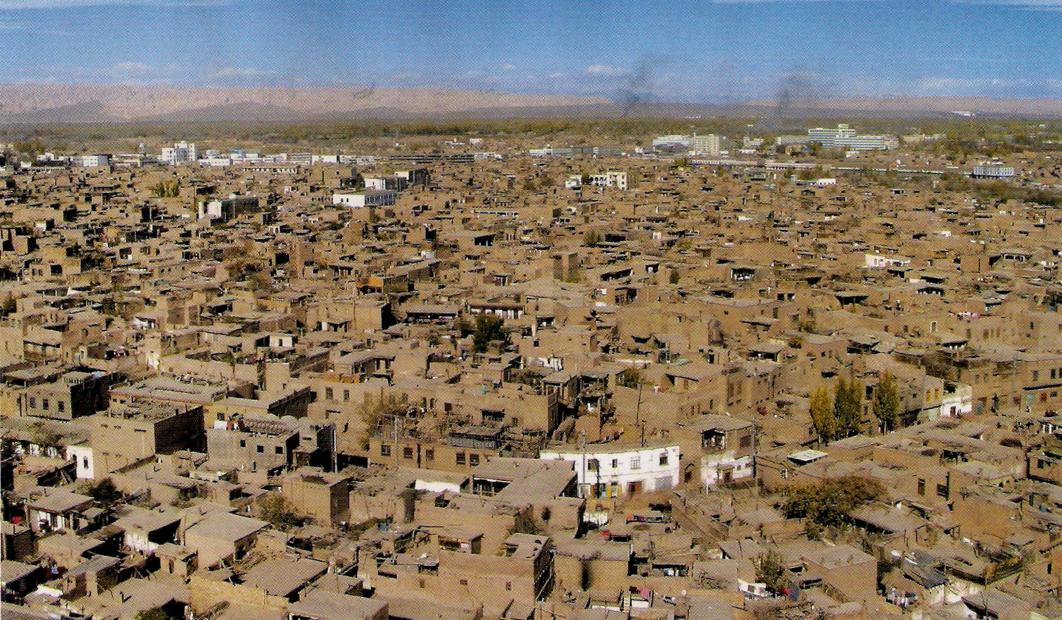
I entered Kashgar near the end of a two-week trip on China’s historic Silk Road.  By this point, I had already hurt my stomach considerably through overeating.  I was in a food coma and walked through the old part of the city like zombie. Still, I remember the sky, the sun, the bricks, the dirt, and occasionally the children who poked their heads out from the curtains that provided the only privacy from the outside world.  The time is near noon, the atmosphere is peaceful, however, our nonstop pace more reminiscent to soldiers on a battlefield than anything serene. Perhaps it was because too many tourists wanted to see the “Old” part of the city, but our tour guide had to rush us similarly to a shepherd trying to keep up with a chaotic flock. Everywhere we went we had to walk through ruins and rubble. Later on (after I had read more about the cultural and political conflict between the Han and the Ugher) I realize I had stumbled upon a very controversial city plan: bull doze the old city to rebuild a better and safer new city in Kashgar.  What I saw before me was a place in the progress of simultaneous destruction and construction.

Even with my upset stomach, I can shut my eyes to the discoveries around every corner, I love this part of town and wish I could spend more time visiting every shop and snapping more pictures of people.  Whether this beautiful, charming, and historic part of the city would survive the seemly unavoidable urban renewal, in my opinion, lies not in a completely practical, but clear artistic vision: pentimento. If you prefer clean-cut shapes, brilliant color, modern design, and straight pathways, go head, rebuild the city and mold it into a perfect model. However, if you enjoy the layers of history on the walls and hanging off the rooftops, the organic dwellings, winding streets, then you ultimately choose to repent these new changes, and instead choose to allow a place to grow in its own bio rhythm. The old city in Kashgar not only represents a way of living but also involves political power dominance. As an artist, educator, tourist and world citizen, I really hate to see the old part of the unique life style disappear in Kashgar or in the world.  Please let the old city be, and do no more harm.

My convergence to this old city of Kashgar ends with a photo essay The Veils of Aleppo by photographer Franco Pagetti. As civil war rages around them, residents of Syria’s largest city use colorful sheets to shield their homes and streets from the rifle scopes of snipers. The veils of Aleppo are the final act against human despair in war.  I hope whatever the final solution is from the Chinese housing authority that instead of choosing a path of total destruction they instead decide remember those that have come before and to preserve the integrity of the old Kashgar.

A bird's eye view of Kashgar's Old City in Xinjiang, ChinaKashgar's Old City
www.farwestchina.com

Sunday, August 25, 2013

Hats on Heads

It is not strange to take pictures of yourself when you travel along. However, holding camera with a short arm, resulting in pictures with close-up heads is just another opportunity for self indulgence. During my trip to China, I had to remind myself to let someone take pictures of me in the environment so I could use the photos for publicity.  This group of head thumbnails is, in fact, thumbnails of me with famous landmarks. These heads also act as an reminder to me of  three weeks of intensely hot weather. There is one thing my son gave me before my trip to China saved my life. A pair of shoe laces. I used one for my hat and one for the belt. In Shanghai, I had to throw away a lot of my clothes to make room for books: I kept the shoelaces.


.

Tuesday, August 13, 2013

Taking up the Silk Road Dream

Crescent spring, Dunhuang

7/5/2013 10:15 AM I walked into the Forbidden City - three days later I left the Great Wall, retracing an ancient path and uncovering stories of trade, power, beliefs, art, love and death on the Silk Road in China’s Xinjiang Autonomous region.  My travel group was made up of 21 fellow adventurers and educators from all over the United States. At the end of two weeks of breakneck trekking to the western border of China, from Beijing to Kashgar we finally arrived in Shanghai. We were lead by Karen Kane and Roberta Martin from Columbia University, Harold Tanner from the University of North Texas, and Jeff Kyong-McClain from the University of Arkansas at Little Rock. In addition, in every city we visited, five national and regional professional tour guides would join our group.

The two-week journey was a discovery of visual and intellectual enlightenment. We combined the exploration of archaeological sites with historical points of interests, ancient ruins, and museum visits. At every destination there was in depth, site-specific, topics of discussion. For instance, we explored the excavation Museum of Terra Cotta Warriors and Horses, which was a stark contras to the pigs and dogs which depicted domestic life in Han Yang-ling’s tomb. I flew to Dunhuang, and saw Mogao Grottos with a pilgrimage to cave #17 – a Library Cave.  Here, I toured Bezeklik’s Thousand Buddha Cave as well.  I rode on donkey cart through the Gaochang Ruins where the monk Xuan Zhuang had lectured upon his return from India to Xi’an with the Buddhist scriptures.  I entered Kashgar and explored the great Id Kah Mosque and street markets.  My footsteps traced Heavenly Lake in Tianshan and down to the Turpan underground Karez.  I spent memorable days under the grape vines at private Uyghur houses and concluded the trip with an excursion to the fascinating Sunday Bazaar in the westernmost point of China.

At the conclusion of the course laid out by my traveling group, I continued my journey in Shanghai where I booked into a cheap hotel, my travel hut, and started a weeklong series of day trips to neighboring cities. These trips lead me to I.M. Pei’s Suzhou Museum, and a tour of West Lake and the China Academy of Art campus in Hangzhou.  I was so touched by the TV Show: “The Patriot of Fe Yue” that I sought out Yue Fe’s gravesite in record heat (42 C) on a Wednesday afternoon in Hangzhou.  I took many buses to many water towns, walked through many streets to see temples and gardens. Equipped with only a hat, an umbrella, and a towel on my neck, and several bottles of water in my backpack on these sightseeing escapade and somehow survived an unprecedented hot July in Shanghai.  Eventually, after visiting the Shanghai museum three times, I finally decided that I had seen all its collections and did my final purchases of books and souvenirs and left China to return to the USA.

Throughout the trip, I sketched on-site, and in the dark; collected tickets, maps, and booklets.  I snapped more than 4500 pictures (thank goodness for digital cameras and my Iphone).  My travel collections also include recorded videos with the Uyghur people singing and playing instruments. I purchased, in Kashgar, a Daira (a frame drum) and intend to practice it on my own.  Entering the Muslim world is an unbelievable experience, like exploring a distant continent.  I respect every aspect of the Uygur people’s life and await an opportunity to encounter China’s Central Asia.  There was so much all around me that I fear I missed many important historical sites by just an arm’s length.  Well, traveling in China, you’re bound to miss something and find something unexpected in return. 

Gaochang Ruins
Gaochang Ruins
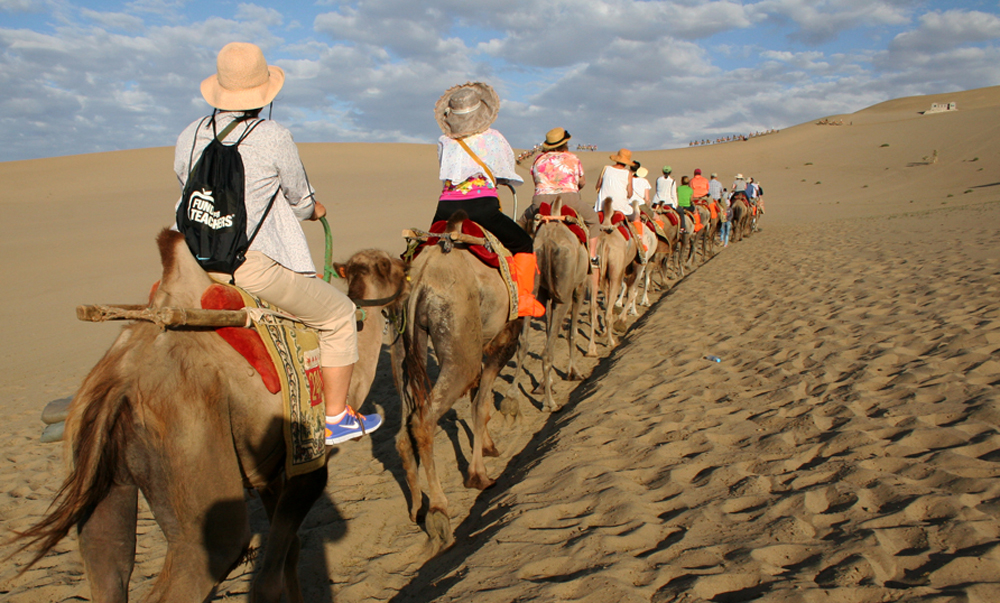
desert ride on camel back, Dunhuang

Visiting the Great Id Kah Mosque, Kashgar


Sunday, June 30, 2013

Beyond the Great Wall


It was a long time ago, while still in grade school, I learned about the Silk Road. In July, I will be on my way to China and Silk Road for the first time. I shall visit many places outside the Great Wall; those cities I have a hard time to pronounce their names; I shall let my emotion float like a small raft on the Yellow River; I shall let my eyes wonder over the mountains and across the hills; I shall let my heart pound when I step onto the old walls and roads; I shall let the sun and the sand fill me up and take me to the markets,  for the land I stand on was once an ancient kingdom . I shall sing and dance and drink lots of tea; Finally, I shall visit Dunhuang cave and pose in silence in front of their religious murals.

Without Fund For Teachers Grant, NCTA field study opportunities and Columbia University Weatherhead East Asian Institute's organization, it  would be impossible for me to leap into a journey that I was destined to start forty years ago.  I am leaving Tulsa tomorrow to meet with the group and continue the journey  to China for three weeks.  I will bring silk and a pocket of dirt back.  Stay cool my family and friends!


I cannot  sleep
For the blaze of the full moon.
I thought I heard here and there
A voice calling.
I answer "Yes"
To the empty air.

***

Thanks to Karen Kane and Roberta Martin from the Columbia University, we have some fantastic reading materials:

http://virtuallabs.stanford.edu/silkroad/SilkRoad.html

Online Silk Road History
http://www.ess.uci.edu/~oliver/silk.html

Online Silk Road resources:
http://www.chlive.org/pbeck/eastlibrary/SILKROADRESOURCES.htm#PRIMARY%20SOURCES

The curriculum guide "From Silk to Oil"
http://www.chinainstitute.cieducationportal.org/education/for-educators/curriculum-resources/curriculum-guides-units/

The Silk Road: An Educational Resource
http://www.asian-studies.org/eaa/silkroad.htm

Yo-Yo Ma's Silk Road Project
http://www.silkroadproject.org/

Asia for Educators program at the Weatherhead East Asian Institute


Online Museum Resources on Asian Art (OMuRAA), particularly the Featured Topics: Art and Trade of the Silk Road and Asian Religions: Buddhism, Nestorian Christianity, Islam, Manichaeism, and Zoroastrianism.


Three "must-see" cities on the Silk Road

A quick list of cities along the complete Silk Road (beyond China)

http://annmah.net/articles/secrets-of-the-silk-road/

Good resource for current news on Uyghurs in China

http://www.rfa.org/english/news/uyghur

"The Year of Dunhuang" at the China Institute in NYC and online


Photography exhibition by Lisa Ross at the Rubin Museum

http://www.rmanyc.org/events/load/1908

Reading "Gatsby" in Beijing Evan Osnos (New Yorker, Letter from Beijing)

http://www.newyorker.com/online/blogs/comment/2013/05/reading-gatsby-in-beijing.html

Xinjiang-China’s Central Asia by Jeremy Tredinnick